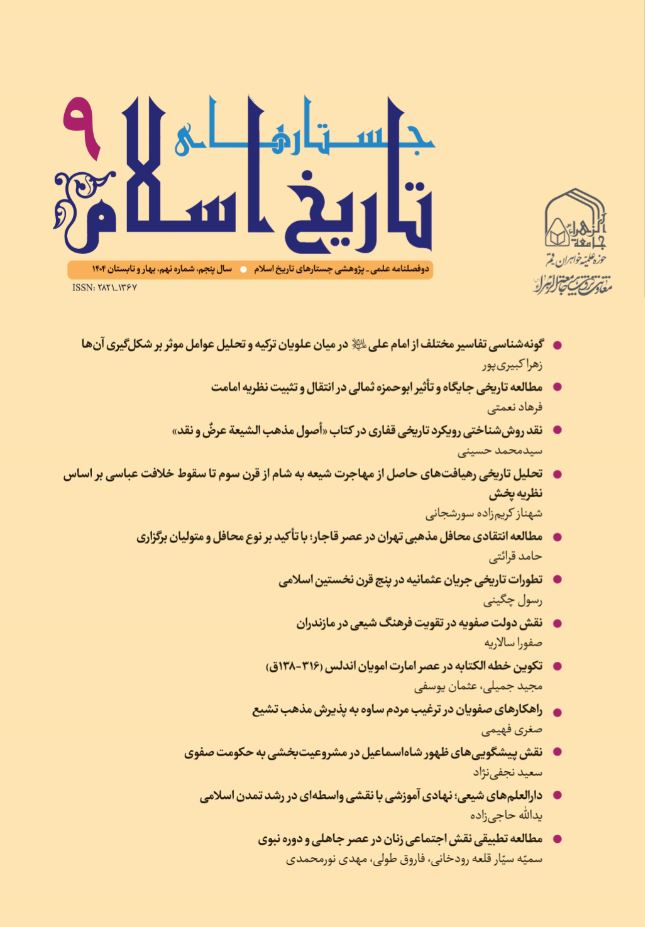
نوع مقاله : مقاله پژوهشی
عنوان مقاله English
نویسندگان English
Abstract
One of the significant issues raised in discussions of Islam concerns its perspective on women, a matter that becomes clearer when compared with the society of the Arabian Peninsula prior to the advent of Islam, where both similarities and differences can be identified. In the pre-Islamic period, women held limited social roles and were often assigned instrumental functions within political, military, and economic spheres. With the advent of Islam, prevailing attitudes toward women changed, and new domains for their social participation were opened. The main objective of this study is a comparative examination of the social roles of women in Arabia before and after the advent of Islam. The main research question addresses the extent to which, and the ways in which, Islam transformed patterns of women’s social participation in comparison with the Age of Ignorance (Jāhiliyya). The research employs a descriptive–analytical method, drawing on library-based sources, including historical, hadith, and interpretive works. The study argues that Islam employed three approaches—affirmation, reform, and establishment—in addressing women’s social roles, thereby enhancing their social status. For instance, in the pre-Islamic era, women’s participation in allegiance (bayʿa) and warfare was limited and largely symbolic or motivational, whereas in the Prophetic period these roles became more structured and supportive. Similarly, women’s involvement in trade expanded from indirect participation to independent economic activity, and their religious–social participation, such as in pilgrimage (ḥajj) and congregational prayer, was purified of superstitious elements and formally recognized. These findings reflect a broader transformation in religious and ritual attitudes toward the status of women in Islam.
کلیدواژهها English